We have a major positive impact on the economic development of the regions where we operate. We are helping to improve lives through our investment in local communities, facilities and infrastructure. We also support local, regional and national economies through tax transparency, hiring local employees and using local suppliers.
When we first invest in a new mining project, we evaluate the potential impact of our operations in the designated area. We understand the importance of the indirect impacts of our operations on local communities. Each year we commit considerable resources to assessing these impacts and ensuring that our activities promote social and economic wellbeing among local communities. We enter into agreements with local governments, institutions and public organisations to ensure all programmes can be delivered in a way that derives maximum benefit for local communities.
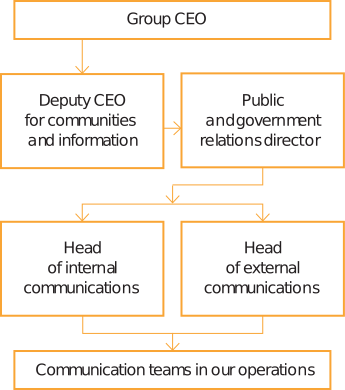
The success of our communities programme is built upon open dialogue and engagement. These principles are embedded in our
External communication channels
Engaging openly and systematically with stakeholders is a core component of our environmental and social management approach and an essential condition for maintaining our social licence to operate. We recognise that mining and processing projects may raise questions and concerns among local communities, particularly during the planning and development stages. We therefore conduct structured stakeholder engagement as an integral part of project design, environmental assessment and decision-making, in line with national legislation and international standards, including the EBRD Performance Requirements, the Equator Principles and IFC Performance Standard 1.
All of our development and expansion projects are subject to Environmental Impact Assessments (EIA) in accordance with the requirements of Kazakhstan’s Environmental Code. These assessments include disclosure of project information, public hearings and formal consultation processes, ensuring that potentially affected communities and other stakeholders have an opportunity to review project documentation, ask questions and express their views before key permitting decisions are made. For large-scale and strategically significant projects, we go beyond national requirements and conduct comprehensive Environmental and Social Impact Assessments (ESIA) aligned with international best practice. These assessments are carried out by independent consultants and include detailed baseline environmental and social studies, impact assessments, alternatives analysis and the development of mitigation and management measures. A central component of the ESIA process is meaningful stakeholder engagement, which ensures that stakeholder perspectives are incorporated into project planning and design.
Our approach to stakeholder engagement is formalised in the External Stakeholder Engagement Standard, which is implemented at each operating site and development project. In addition, our commitment to respecting human rights and ensuring responsible and inclusive engagement with local communities is embedded in our Human Rights Policy and Code of Conduct, which establish overarching principles for ethical behaviour, transparency and stakeholder interaction.
At Board level, oversight of environmental and social stakeholder engagement is exercised by the Safety and Sustainability Committee. The Committee is responsible for monitoring compliance with applicable environmental and social standards and reviewing the Company’s overall performance in sustainability and environmental and social responsibility. This governance structure ensures that stakeholder engagement outcomes are visible at the highest level of the organisation and integrated into strategic oversight. For example, in 2025, the Committee and the Board twice reviewed the progress of the Ertis POX ESIA process, including updates on stakeholder engagement activities, disclosure timelines and the integration of assessment findings into project planning and decision-making.
Operational responsibility for planning and implementing environmental and social stakeholder engagement activities is shared between our environmental and external communications functions. Environmental departments are responsible for the content of engagement, including the disclosure of environmental information, the explanation of potential impacts and mitigation measures, and the incorporation of stakeholder feedback into project planning. External communications teams coordinate the engagement process itself, ensuring inclusive and fair stakeholder representation, accessibility of disclosure materials and the effective operation of feedback and grievance channels.
Operating assets
Kyzyl (asset development and transition to underground mining)
5 public hearings
Varvara hub (Varvara energy hub project)
2 public hearings
Komar mine (asset development and Elevator project)
5 public hearings
4 public discussions
Total: 100% of operating assets were involved into stakeholder and community engagement
Development projects
Ertis POX
4 public hearings
1 ESIA engagement campaign
Baksy
2 public hearings
Syrymbet
— (planned in 2026)
Exploration (6 projects)
11 public hearings
Total: 89% of development projects were involved into stakeholder and community engagement
Our engagement approach is guided by the principle of meaningful consultation, which goes beyond formal disclosure to ensure that stakeholders are informed, able to participate effectively and confident that their views are taken into account. Stakeholder engagement activities are conducted at appropriate stages of the project lifecycle, in accessible formats and locations, and supported by clear, understandable information.
During 2025, engagement activities related to our development projects included:
These engagements provided stakeholders with opportunities to raise questions related to environmental protection, water management, air quality, biodiversity, employment opportunities and potential impacts on quality of life. All feedback received was documented and reviewed by the project and environmental teams, with responses provided and, where relevant, mitigation measures incorporated into project planning.
Engagement outcomes are formally documented and integrated into risk assessments, mitigation planning and project design. For projects under development, stakeholder feedback is reviewed alongside environmental, technical and financial considerations, ensuring that environmental and social factors are fully integrated into investment decisions and project execution.
This approach ensures alignment with our lenders’ requirements for meaningful consultation, supports transparent, inclusive decision-making and aligns with international expectations for responsible project development and transparent disclosure of assets undergoing active stakeholder consultation.
We recognise that stakeholder engagement is an ongoing process that continues throughout construction, operation and closure. For development projects, Stakeholder Engagement Plans are established to guide continuous communication, including grievance mechanisms, periodic consultations and public reporting.
Through this approach, we aim to:
Our commitment to stakeholder engagement reflects our broader sustainability strategy and ensures that our growth projects are developed in a manner that respects community interests, protects the environment and meets international expectations for transparency and accountability.
Every single one of our sites and facilities provides employment opportunities for local people. As well as paying regional taxes, we invest in local communities — funding education, health, culture and infrastructure. We also work to minimise any negative impact of our business on society, aiming to incorporate local community requests, for example at all stages of planning and development.
Our investment priorities are determined through open dialogue with local communities. As part of this process, we carry out in-depth analysis of local people’s needs and work with them to understand how social investment could best bring positive change to their lives. Together, we identify the most pressing local issues and define the scope of the support required.
We are committed to creating in-country employment opportunities and hiring from local communities at our major operational sites, we aim to create local value and improve people’s livelihoods and lives.
Employing locally has many benefits — it helps to strengthen ties between our business and communities where we operate. It lowers our costs and environmental impact, by not having to ‘fly in and fly out’ as many employees from other areas. It means employees — even before day one — are already dedicated to the well-being of the local community. It helps us to increase our positive impact on local economies. 95 % percent of our employees are local residents, depending on the location of the operation.
Today, no company can afford to ignore the risk of security. Solidcore takes a structured approach to providing safety and security from internal and external threats. The measures are aimed at eliminating threats and preventing possible material and financial risks, providing safe operating conditions for employees and assets.
The activities of the security services and other divisions involved in ensuring security are regulated by related guidelines in accordance with the Company’s
When selecting security organisations, we check their professional training and reputation. Our in-house security supervisors at operations monitor and evaluate how services are conducted by security companies. The security employees co-ordinate with local authorities and regional and municipal law enforcement agencies. Together, they develop action plans and exchange information to prevent threats. Security supervisors inform the heads of relevant departments and operations about any internal or external threats.